Our Sheffield story
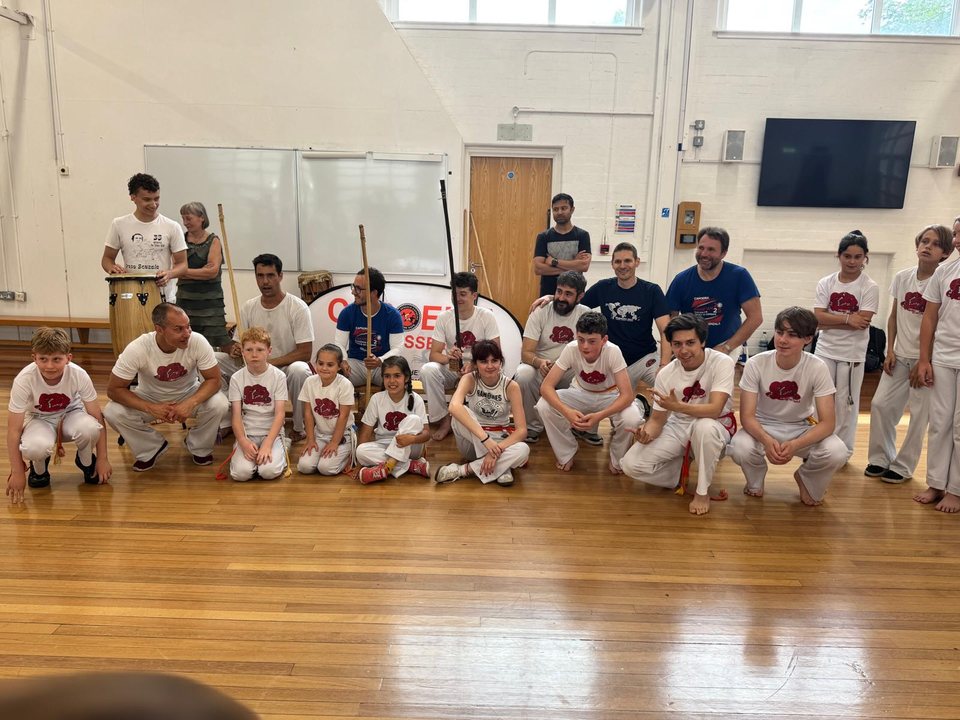
Capoeira Senzala Sheffield was founded in 2010 by Professor Socadinho. The school belongs to Grupo Senzala, with a connection to Mestre Gato and his son Mestre Pedro and to the group’s roots in Rio de Janeiro.
Our purpose is to encourage participation in capoeira and the Brazilian cultural activities that surround it. The school’s work includes classes for adults and children, school and community workshops, events and performances. Enquire directly about current arrangements for workshops or performances.
For someone arriving for the first time, capoeira can be many things at once: a physical challenge, a musical experience and a way of meeting people. Our Sheffield class timetable is the place to start, whether you are enquiring for yourself or your child.
A game, not a routine
Capoeira brings martial movement, acrobatics, dance and music together in a game. Its exchanges are improvised rather than rehearsed: a kick invites an escape, an opening invites a response, and each player changes what the other might do next.
There is a fascinating balance between cooperation and challenge. The players need each other to make the game, but neither can predict its course. Skill involves awareness, timing and communication as well as physical movement.
Learning capoeira therefore means more than learning an impressive move. It also means understanding how to listen, respond and give someone else space to play.
Afro-Brazilian roots
Capoeira is inseparable from Brazil’s history and from the resistance and cultural expression of enslaved African people and their descendants. Its story includes slavery, exclusion, persecution and the determination to keep cultural practices alive.
There is no single, universally agreed account of its beginning. Oral traditions, different regional experiences and the passage of time have produced multiple histories. Bahia, and particularly the area around the Bay of All Saints known as the Recôncavo Baiano, has a central place in that story.
Angola and Regional are two well-known traditions within capoeira, but neither label describes all the variety found within the art. Capoeira has changed as generations of practitioners have learned from one another and carried it into new communities.
The original essay on this school’s website, attributed to Mestre Pedro, emphasised this diversity and capoeira’s capacity to adapt. It also described the use of capoeira in community and social projects. That cultural context remains an important part of how we present the art, rather than reducing it to fitness alone.
Everyone belongs to the roda
The roda is the circle in which capoeira is played. Two players enter the space, but the whole circle helps create the experience. The berimbau leads the music, while instruments, singing and rhythmic clapping help shape the pace and atmosphere.
Songs carry stories and traditions. The chorus connects the people watching with the people playing. This shared energy is often described as axé.
You can contribute through a movement, a response, a clap or a song. The music is not background decoration: it is part of the language of the game. Visit our music and learning resources to explore the instruments and rhythms.
A living connection to Grupo Senzala
Grupo Senzala grew from friends training together in Rio de Janeiro in the early 1960s. Its history includes experimentation, close exchanges between teachers and students, and a growing international community.
That connection is personal as well as historical. Read about Professor Socadinho, Mestre Pedro and Mestre Gato, or explore the fuller history of Grupo Senzala.
Keep exploring
Explore the music, history and people behind the Sheffield school.
Grupo Senzala history / Music of the roda / Further resources